How does a water-water heat pump work?
Most people are familiar with air-to-water heat pumps and geothermal heat pumps. But what exactly is a water-to-water heat pump?
In the world of heat pumps, it is something of an exotic creature, as it draws its thermal energy from groundwater, which is not always easily accessible. In this guide, we explain the conditions under which you can install a groundwater heat pump. You will learn how the technology works and what its advantages and disadvantages are.
The operating principle of the water-water heat pump
Unlike gas or oil heating systems, which burn fossil fuels and release CO2, water-to-water heat pumps fall into the climate-friendly category of “renewable heating.” They use the natural heat energy of groundwater and convert it into heating energy. In our latitudes, groundwater has a constant temperature between 8 and 12 degrees Celsius regardless of the season. This temperature stability makes groundwater an extremely reliable and efficient heat source for heat pumps.
By the way: The first “water” in the name water-water heat pump refers to the heat source groundwater. The second “water” stands for the heat distribution system in your home: the heat extracted is transferred to the heating water, which then circulates through the radiators or underfloor heating. If you see the term water heat pump, this usually refers to a water-water heat pump.

How to use groundwater temperature to operate your heating system
Like any heat pump, a water heat pump raises the temperature of the heat source to a level that can be used for heating or hot water production. Technically, this is achieved by the heart of every heat pump, the so-called heat cycle. The correct technical term for this is the refrigeration cycle.
It uses the physical properties of special refrigerants to absorb heat from the environment and make it usable for heating purposes. These refrigerants evaporate even at very low temperatures. One example is the natural refrigerant R290 (propane), which has an astonishing boiling point of minus 45 degrees Celsius. You can find more details on this topic in our blog post about heat pumps that run on propane.

From the heat source to the heating system
Before the cycle begins, groundwater is transported from a specially constructed extraction well, also known as a suction well, to the evaporator of the water-water heat pump via a pipe system using an underwater pump. Here, the circulating refrigerant absorbs the thermal energy from the groundwater and evaporates due to the significantly lower boiling temperature. The refrigerant vapor, now in gaseous form, is fed into the compressor, where the temperature of the refrigerant gas rises significantly again under high pressure. This process is comparable to the principle of a bicycle pump, in which the compressed air heats up. In the next component, the condenser, the high-temperature gas transfers its energy to the heating system. In the process, it cools down and liquefies again. The heat gained is distributed throughout the house via underfloor heating, radiators, and other heating systems, or used to heat water.
In the final step, the liquid refrigerant is passed through an expansion valve, where it expands and its temperature drops further. It flows back to the evaporator, where the cycle begins again. The water from which the heat has been extracted is returned to the groundwater by the heat pump via a second well, the absorption well.
HOW THIS WORKS IN PRACTICE:
Water-water heat pump: advantages and disadvantages
Water-water heat pumps are characterized by outstanding efficiency and have annual performance factors that are at least as high as those of brine-water heat pumps. With efficiencies of up to 500 percent, they can generate an impressive five kilowatt hours of heat energy from one kilowatt hour of electrical energy. So why aren't they the heat pump of choice more often?
According to the German Heating Industry Association, of the 141,500 heat pumps sold in Germany in 2024, only around 1,500 were water-water heat pumps, which corresponds to a meager share of around one percent. We have compiled a brief overview of the pros and cons of installing water-water heat pumps.
ADVANTAGES OF A WATER-TO-WATER HEAT PUMP
- High efficiency (high seasonal performance factor) and low operating costs
- Consistent performance throughout the year, regardless of outside temperatures
- Space-saving, as no large ground collectors are required
- In many cases, the groundwater is fed directly to the heat pump without efficiency-reducing heat exchangers (ground collectors, probes, or intermediate heat storage tanks)
- Environmentally friendly through the use of renewable energy
- Long service life of the system
- Possibility of cooling in summer
Disadvantages of a water-water heat pump
- Comparatively high investment costs for initial installation
- Approval procedures and geological surveys required
- Dependence on sufficient groundwater quality and quantity
- Regular maintenance and cleaning of wells necessary
- Possible restrictions due to water protection areas and low groundwater levels
- Risk of groundwater contamination if installed improperly
A note on this: Falling groundwater levels are becoming an increasingly serious problem in Germany. This can be a decisive disadvantage for the operation of water-water heat pumps, as they depend on sufficient groundwater.
You therefore need to plan thoroughly and talk to experts about whether the groundwater under your property will be able to supply the energy for a water heat pump in the future. Many federal states offer groundwater level maps.
WZSV 63
GEOTHERMAL ENERGY WITH NATURAL REFRIGERANTS
Brine/Water-Heat Pump

Water-water heat pump: Requirements
The installation and efficient operation of a water-to-water heat pump are subject to certain geological, technical, and legal requirements. Before you decide on a water-to-water heat pump, you should carefully consider the following aspects:
GEOLOGICAL CONDITIONS
The most important prerequisite for operating a water-water heat pump is the availability of groundwater in sufficient quantity and quality. Several factors play an important role here:
- Groundwater level: Ideally, the groundwater level should not be deeper than 15 to 20 meters below the earth's surface. At greater depths, the costs for well drilling and pump operation increase, which can affect the economic efficiency of your water-water heat pump.
- Groundwater quantity: A sufficient amount of groundwater must be available. As a rule of thumb, approximately 0.2 to 0.3 cubic meters of water per hour are required per kilowatt of heating capacity.
- Groundwater quality: The chemical composition of the groundwater is very important. Too high a content of iron, manganese, or other minerals can lead to deposits and corrosion in your heat pump. A water analysis is therefore essential.
- Groundwater temperature: The ideal temperature of the groundwater is between 8 and 12 degrees Celsius. This temperature remains relatively constant. This means you can operate your heat pump at high efficiency all year round
TECHNICAL REQUIREMENTS
In addition to the geological conditions, certain technical requirements must also be met before you can use your water-water heat pump.
- Wells: Two wells are required – a production well (suction well) for extracting groundwater and an absorption well (seepage well) for returning the cooled water to the ground after heat extraction.
The production well is equipped with an underwater pump. The depth of the well varies depending on the groundwater level and is typically between 5 and 20 meters. The recharge well must be able to absorb the same amount of water that was previously extracted from the extraction well. To prevent the cooled water from entering the extraction well, the two wells are constructed at a minimum distance of 15 meters apart. The recharge well is located downstream of the extraction well in the direction of groundwater flow to ensure optimal water return and distribution.
- Space requirements: Although the heat pump itself is relatively compact, there must be sufficient space on the property for the well systems.
- Heating system: Water-to-water heat pumps work most efficiently with low-temperature heating systems such as underfloor heating or large radiators. In older buildings, energy-efficient renovation may be advisable in order to achieve optimum efficiency.
- Power supply: An appropriate power connection is required to operate the submersible pump and the heat pump's compressor.
LEGAL FRAMEWORK
The use of groundwater is strictly regulated. This also has an impact on the commissioning of a water-water heat pump:
- Permit requirement: The installation of a water-water heat pump is usually subject to approval. The responsible water authority must grant permission for groundwater extraction and return.
- Water protection areas: In designated water protection areas, the installation of a water-to-water heat pump is often not permitted.
- Building regulations: In addition to water law permits, building regulations may also be relevant.
Environmental requirements: Precautions must be taken to prevent contamination of the groundwater
TIPS FOR PLANNING AND PREPARATION
Due to the wide range of requirements, careful planning of your water-to-water heat pump is essential. Be sure to seek advice from an experienced specialist company that is familiar with the specific requirements of water-to-water heat pumps. You can find an alpha innotec specialist partner company in your area here. What else you need to consider before you can benefit from the advantages of your groundwater heat pump:
- Hydrogeological report: An expert report provides information about the suitability of the location and the expected performance of the system.
- Heating load calculation: An accurate calculation of the heat demand is essential in order to optimally dimension the performance of the heat pump and ensure its maximum efficiency. Our specialist partner companies are trained for this.
- Duration of the approval process: It can take some time to obtain all the necessary approvals. You should therefore start as early as possible.
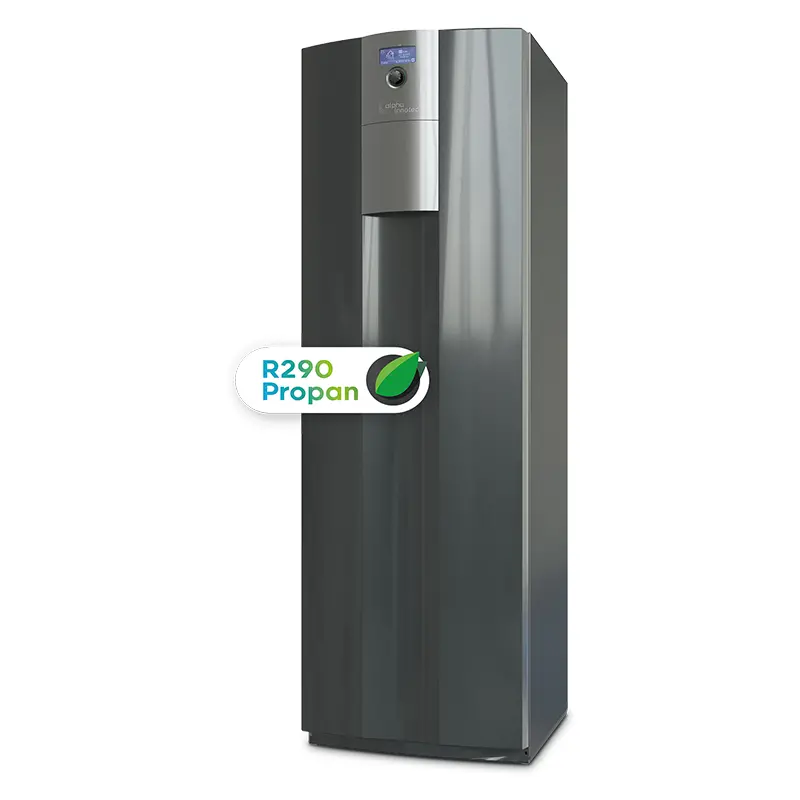
WZSV 63
• Inverter heat pump
• Refrigerant R290
• Building heating load: 3-6 kW
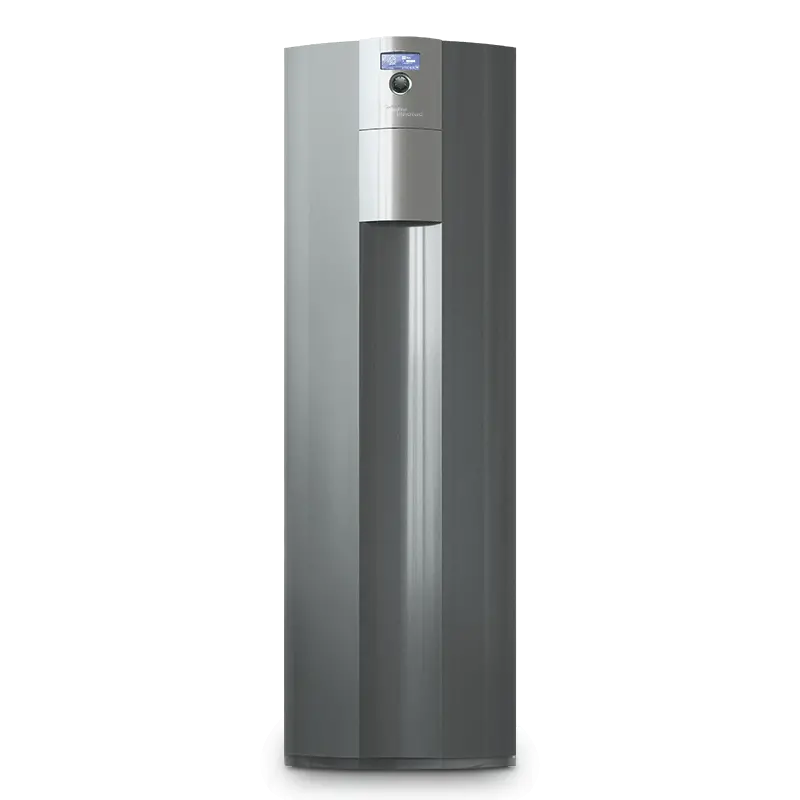
WZSV Serie
• Inverter heat pump
• Refrigerant R410A
• Building heating load: 3-14 kW
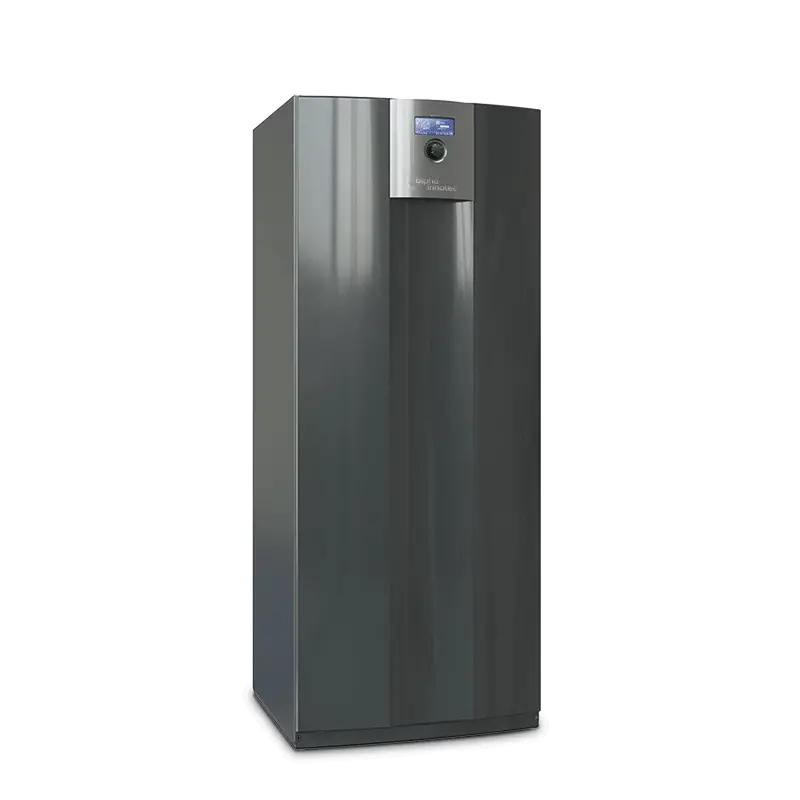
SWCV Serie
• Inverter heat pump
• Refrigerant R407C
• Building heating load: 3-17 kW