Combining photovoltaics with a heat pump—is it really worth it?
More and more homeowners are asking themselves: “Is it worth combining photovoltaics and heat pumps?” The answer is yes. If the conditions and dimensions are right, a PV system can optimally supply the heat pump with inexpensive solar power. This reduces heating costs, increases self-consumption, and shrinks the carbon footprint.
In just 10 seconds:
- Photovoltaics and heat pumps form a powerful duo for climate protection and heating cost savings.
- 30–50% of the electricity required for heat pumps can be covered by your own solar power.
- The investment costs are between €25,000 and €50,000, but subsidies reduce these considerably.
- The investment usually pays for itself after 10–15 years.
- Particularly useful for insulated buildings with panel heating.
How do heat pumps and photovoltaics work?
In short: With photovoltaics, you can operate your heat pump largely with your own electricity, reduce your purchases from the grid, and increase your independence.
Photovoltaic modules generate electricity during the day, which the heat pump can use directly. Surpluses can be temporarily stored in a battery storage unit or “stored” in the form of heat in a buffer storage tank or hot water tank. The heat pump, storage tank, and other consumers (e.g., wallbox, household appliances) can be intelligently controlled via the SG-Ready interface or an energy management system (EMS).
The result: more self-consumption, lower electricity costs, and a higher degree of self-sufficiency.

Is combining a heat pump and PV worthwhile? Advantages and disadvantages
“In 2023 alone, over one million new PV systems were installed in Germany for the first time,” reports the Fraunhofer Institute for Solar Energy Systems in a short study on the growth of battery storage and balcony PV in Germany.
This development clearly shows that the energy transition is gaining momentum. Photovoltaics is particularly sustainable and sensible when combined with a heat pump.
Advantages | Disadvantages |
|---|---|
Significantly lower electricity and heating costs | High initial investment |
Use of renewable energies (sun + environmental heat) | Limited PV yield in winter |
High energy efficiency, as the heat pump delivers more heat than it consumes in electricity | Time discrepancy between PV yield (day) & heating demand (evening) |
Maximize own consumption instead of feeding into the grid | Storage & EMS increase additional costs |
Greater independence from electricity prices & suppliers | Requires roof space & planning |
Government subsidies | More complex system technology |
Smart home integration possible | |
Increased property value |
|
Our tip: A heat pump with photovoltaics is particularly worthwhile for insulated buildings with surface heating and moderate heating requirements.
What are the requirements for a heat pump and photovoltaic system in the house?
Certain conditions must be met for heat pumps and PV systems to work together efficiently:
1. LOW FLOW TEMPERATURES
Heat pumps work most efficiently at low flow temperatures of 30–35 °C. This is ideal for underfloor, wall, or ceiling heating systems. Efficiency drops significantly with traditional radiators that operate at high temperatures.
2. GOOD INSULATION STANDARD
An insulated building envelope ensures that less heating energy is required. The lower the demand, the more the heat pump can cover with PV electricity.
3. SURFACE HEATING AND LARGE HEATING SURFACES
The larger the heating surfaces, the lower the flow temperature can be. This increases the annual performance factor (APF) and the efficiency of the entire system.
4. HYDRAULIC BALANCING
Ensures that heat is distributed evenly throughout the house. This saves electricity and prevents individual radiators from being overloaded.
How do I size PV, storage, and heat pump together?
- Photovoltaic system: Usually 8–12 kWp for a single-family home with a heat pump. Depending on the roof area and electricity consumption, it may also be more.
- Heat pump: Heating load calculation is mandatory. Devices that are too large are expensive and inefficient, while those that are too small quickly become overloaded.
- Electricity storage: From 8–10 kWh is useful for using surpluses in the evening.
- Buffer storage: Stores thermal energy and reduces the load on the heat pump.
- EMS: Automatically controls when devices run—e.g., hot water production when there is a PV surplus.
How do I connect a heat pump to the photovoltaic system?
In order for the heat pump to make optimal use of the electricity generated by the solar system, both systems must be technically connected to each other. This is not done with a simple cable, but with a coordinated control system that intelligently coordinates PV yield, consumption, and storage.
STEP 1: INSTALLATION OF THE PHOTOVOLTAIC SYSTEM
First, the PV system is mounted on the roof or in an open space. The inverter converts the generated direct current into alternating current, which can be used directly in the home network. A meter records how much electricity is fed into the grid or consumed in the home.
STEP 2: SELECTION OF A SUITABLE HEAT PUMP
Not every heat pump is automatically PV-compatible. SG-Ready heat pumps are recommended, as they can communicate with the PV system or an energy management system via an interface. This interface signals to the heat pump when surplus PV energy is available.
STEP 3: INTEGRATION OF AN ELECTRICITY OR HEAT STORAGE SYSTEM
A battery storage system is often installed so that PV energy can be used at a later time. It efficiently stores the electricity produced during the day for use in the evening or at night. Alternatively or additionally, a buffer storage tank can be installed: Here, surplus solar power is used to heat hot water or heating water, which is then used later.
STEP 4: SET UP AN ENERGY MANAGEMENT SYSTEM (EMS)
The EMS is the control center: it connects the PV system, heat pump, storage unit, and other consumers (e.g., wallbox, household appliances). Based on forecasts (weather, solar yield) and consumption data, the EMS automatically decides when the heat pump should start—for example, at noon when the PV system is supplying the most electricity. This maximizes self-consumption.
STEP 5: GRID CONNECTION & SAFETY
Even with a good self-supply, connection to the public power grid remains necessary. It ensures security of supply in times without sun and enables surplus electricity to be fed into the grid. A specialist company takes care of the entire electrical connection and ensures that all standards (e.g., VDE) are complied with.
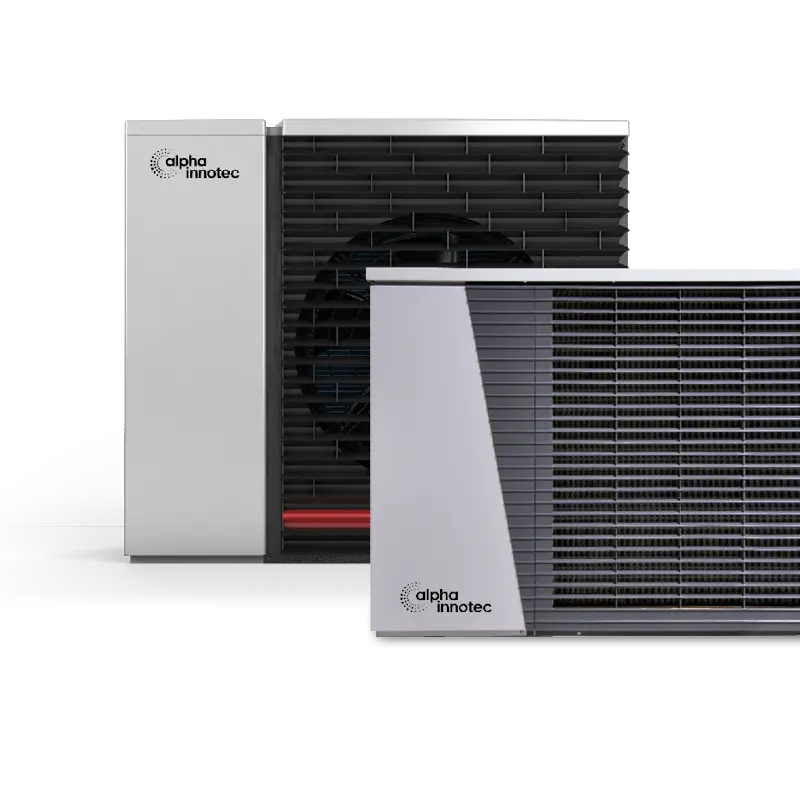
Hybrox Series
• Inverter Heat Pump
• Building heat load: 5-16 kW
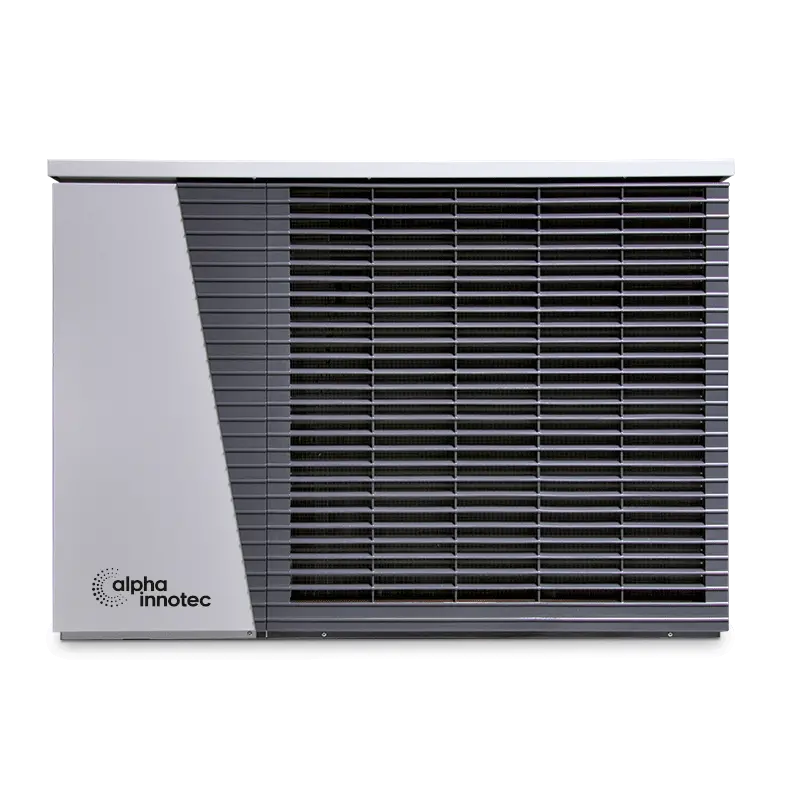
LWDV
• Inverter Heat Pump
• Building heat load: 6-11 kW
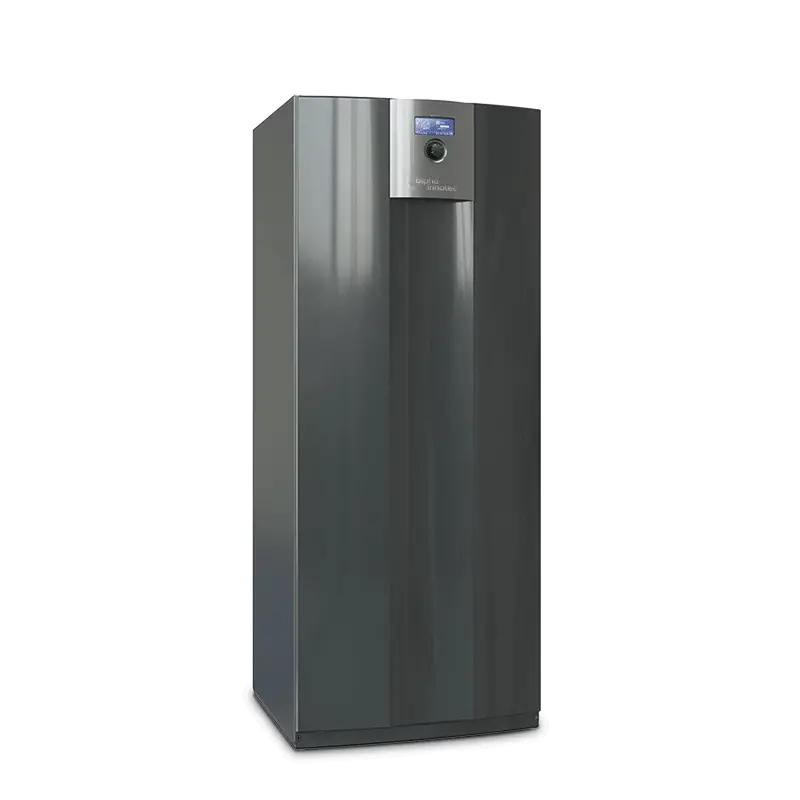
WZSV 63
• Inverter Heat Pump
• Building heat load: 7-12 kW
How much electricity does a heat pump need?
A modern heat pump consumes between 3,000 and 6,000 kilowatt hours of electricity per year, depending on the building, heating load, and hot water requirements.
Marion Kirchner, master plumber and heating engineer; sales manager at alpha innotec Bavaria
The power consumption of a heat pump depends directly on the heat demand of the house and the efficiency of the system. The key figure for this is the annual performance factor (APF), which is calculated as follows:
HP power (kWh/year) = heat demand (kWh/year) / APF
In addition, electricity consumption depends on the type of heat pump. Air-to-water heat pumps generally require slightly more electricity than brine-to-water or water-to-water heat pumps, as outdoor temperatures fluctuate more and the system has to run at higher power more often. Brine and water heat pumps operate more stably and therefore usually achieve a higher seasonal performance factor (SPF).
The building envelope is also a decisive factor: a well-insulated house with underfloor or wall heating requires lower flow temperatures, allowing the heat pump to operate more efficiently. In such cases, SPF values of 4.0 and higher are realistic.
Examples:
- Detached house, 18,000 kWh heat demand, seasonal performance factor 3.5 → ~5,140 kWh/year electricity
- Detached house, 14,000 kWh heat demand, seasonal performance factor 4.0 → ~3,500 kWh/year electricity
- Detached house, unrenovated, 22,000 kWh heat demand, seasonal performance factor 2.8 → ~7,850 kWh/year electricity
How much does a heat pump with photovoltaics cost?
Costs | Reference value (as of 2025) | Notes |
Heat pump (including installation) | 8.000–40.000 € | depending on type (air/water, brine/water), output, and integration |
PV-System (~8–12 kWp) | 8.000–25.000 € | Price per kWp ~1.500–2.100 € |
Buffer storage tank/combination storage tank | 500–5.500 € | for temporary heat storage |
Battery storage (optional) | 5.000–10.000 € | Increases own consumption by up to 50% |
total costs | 25.000–50.000 € | with storage higher, if applicable |
operating costs | approx. 700–1.300 €/year | Depending on heat pump power requirements, PV self-consumption, and grid electricity price |

Blue = capital costs (including subsidies), gray = maintenance costs, yellow = energy procurement costs (excluding BEHG), red = CO² costs (source: WWF 2023)
Amortization of the costs for a PV system with heat pump
The payback period describes how many years it takes for the investment to pay for itself through energy cost savings. For heat pumps and PV, this is usually between 10 and 15 years. The decisive factors here are:
Investment costs after subsidies
Electricity prices and their development
Proportion of own consumption (without storage ~30%, with storage/EMS up to 50%)
Efficiency of the heat pump (JAZ) and insulation standard of the house
Studies such as the WWF-Analysis 2023 show that even with only 30% subsidies, heat pumps are cheaper than gas heating systems over a period of 15 years. With PV, the payback period is reduced even further.
HOW DO I CALCULATE THE PAYBACK PERIOD FOR A PV SYSTEM AND HEAT PUMP?
Calculate net investment costs
Net investment = heat pump costs + PV costs + storage - subsidies
(PV and storage benefit from 0% VAT, heat pumps are subsidized by BEG/KfW.)
Determine annual savings
Savings/year = old heating costs - heat pump + PV costs
Old heating costs: fuel, maintenance, chimney, basic fee.
Combination with solar thermal energy
The following applies specifically to rented properties and apartment buildings: Climate-friendly heating renovation is subsidized with a basic grant of 30% of eligible expenses, up to a maximum of €30,000.
If you opt for a heat pump with a natural refrigerant, you can secure an additional efficiency bonus of 5%.
The following table shows how the maximum eligible costs are staggered in buildings with several apartments. Homeowners' associations submit a joint application to KfW for this basic

Smart Home Integration
If you want to combine your heat pump with a photovoltaic system, a (home) energy management system with an easy-to-use app is an essential part of the package.
This is because intelligent control of your electrical systems and storage units allows you to maximize your consumption of self-generated electricity. The software ensures that your heat pump, photovoltaic system, electricity storage unit, wallbox, heating element, or electric car batteries work together optimally.
Intelligent algorithms take solar forecasts, your consumption behavior, and temperature forecasts into account. The most important advantages:
- Real-time monitoring
- Optimization of self-consumption
- Energy savings
- Remote access
- Data analysis and reports
- Sustainability awareness
- Notifications and alarms











Conclusion: Photovoltaics and heat pumps are a sustainable investment
By using renewable energies and reducing operating costs, investing in a combination of a heat pump and photovoltaics makes both economic and ecological sense. It helps to future-proof your property and make it more attractive in the event of a sale.