Flat-plate collector: The simple solution for efficient geothermal energy utilisation
With a flat-plate collector, you benefit from a particularly efficient and environmentally friendly way to keep your home cosy and warm. The collector's plastic pipes, laid close to the surface in the ground, tap into the geothermal energy of the upper layers of the earth so that you can use it with your brine heat pump. This works all year round, regardless of the air temperature, and enables permanently low heating costs.
In our guide article ‘Heat sources for heat pumps’, we have already shown you where the environmental energy used by a heat pump can come from: air, water and earth.
In this article, we will now take a closer look at flat plate collectors – one of the most popular ways of tapping into free geothermal energy.
In further articles, we will also highlight two other ways of using geothermal energy:
These three variants together form the basis of modern geothermal systems.
The most important facts about ground source heat collectors at a glance:
- Uses geothermal energy at a depth of 1.2 to 1.5 metres
- Particularly efficient in moist, heat-retaining soils
- No deep drilling or complex permits required
- Ideal for new buildings with sufficient garden space
- Low operating costs and long service life
- Can also be used for passive cooling in summer
What is a flat-plate collector?
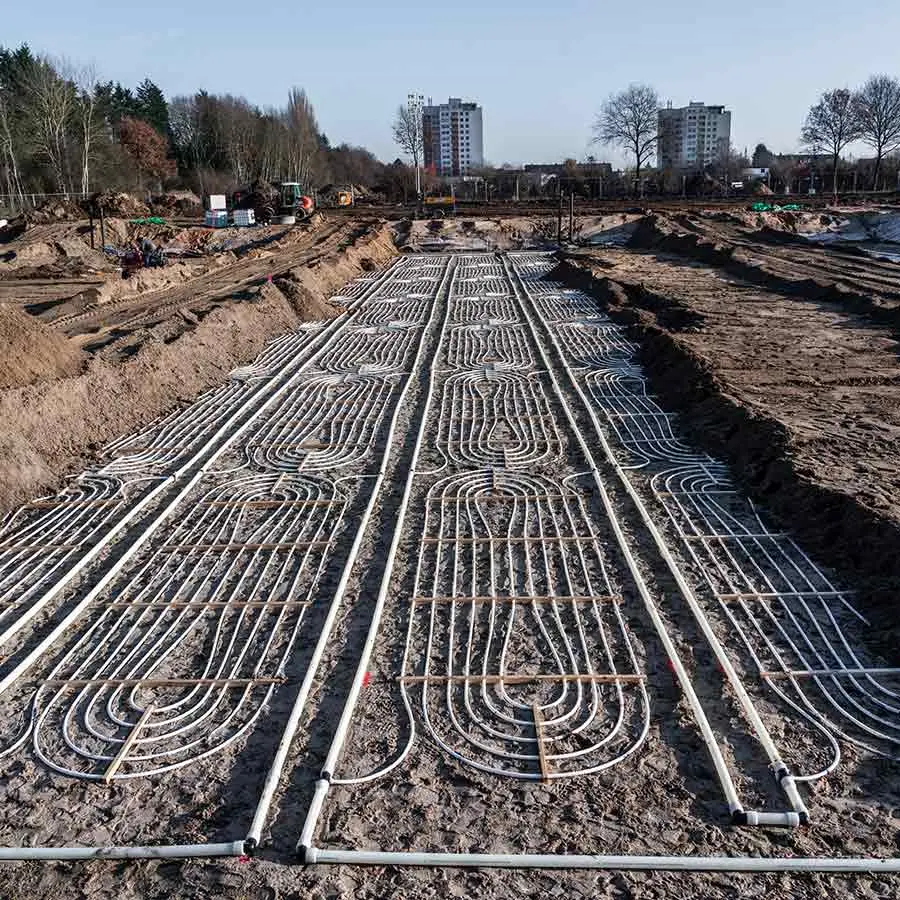
A flat-plate collector consists of a horizontal pipe system that is laid just below the surface of the ground. Although the temperatures in these upper layers of soil fluctuate throughout the year due to the direct effects of sun, rain and frost, they always remain warm enough to provide usable energy. Flat-plate collectors are typically installed over a large area in the garden – hence the name.
The pipes are usually made of durable PE (polyethylene) pipes, which are particularly flexible and long-lasting. They are laid in loops or meanders at a depth of 1.2 to 1.5 metres.
A liquid called brine circulates through the pipes. An antifreeze agent is added to the water-salt mixture to prevent it from freezing in winter. The brine absorbs the heat stored in the ground and transfers it to the brine-water heat pump. From there, it enters the heating system of the house.
The energy obtained is sufficient to heat a well-insulated detached house completely.
The surface collector thus forms an efficient, durable and virtually maintenance-free foundation for sustainable heating with geothermal energy.
How does a flat-plate collector work?
The surface collector is nothing more than a large-area heat exchanger. The PE pipes inserted into the ground ‘collect’ the heat energy stored in the ground and transport it to the heat pump. Heat energy in this context should be understood in physical terms, because in winter the brine temperature in the flat plate collector is only between –2 °C and +5 °C, or even lower.
Although we do not perceive this as warm in the colloquial sense, thermal energy is present, i.e. the kinetic energy of the molecules. This energy is absorbed by the brine in the ground source heat pump and transported to the heat pump. This is why the ground remains a stable source of heat even on frosty days.
The annual performance factor (APF) shows how efficient this is. A well-planned and correctly dimensioned system with a flat-plate collector usually achieves an APF of 4 to 5. This means that the heat pump generates up to five kilowatt hours of heating energy from one kilowatt hour of electricity.
This makes the flat-plate collector a particularly sustainable and economical heating solution.
Flat-plate collector comparison
The efficiency of a ground source heat pump with a flat-plate collector is impressively high. But how does the flat-plate collector compare with other collectors or, more generally, with an air source heat pump?
Surface collector or air heat pump:
Unlike a surface collector, an air source heat pump draws energy from the outside air. The big advantage of surface collectors is that in winter, the geothermal temperature remains much more stable than the outside air temperature. This means that the brine heat pump operates more evenly and efficiently, especially on very cold days. Air heat pumps are therefore less efficient and also louder in operation. On the other hand, they are easier to install.
Surface collector or deep drilling:
Deep drilling provides even more constant temperatures, as it extracts heat energy from depths where the ground is around 10 °C warm all year round. This makes them slightly more efficient than surface collectors. However, deep boreholes require a permit and are significantly more expensive. Surface collectors score points here with lower costs and easier implementation. This makes them ideal for new buildings with sufficient land area.
Flat-plate collector vs. trench collector:
A trench collector combines the advantages of both systems: it requires less space than a classic flat-plate collector, but is similarly efficient. Instead of being spread over a large area, the trench collector runs in a narrow, ring-shaped trench around the house. It is often the better choice if the property is not large.
criterion | flat-plate collector | ring trench collector | geothermal drilling |
depth | 1,2–1,5 m | 1,5–2,0 m (Graben) | 50–100 m |
space requirement | high | medium | low |
expenses | low | medium | high |
licensing requirement
| rarely | rarely | often |
energy efficiency | high | high | very high |
ideal for | new buildings with gardens | new buildings/old buildings with space | small plots of land |
How much does a flat-plate collector cost?
The cost of a flat-plate collector with a brine-water heat pump depends on several factors, such as soil conditions, the size of the property and the energy efficiency (i.e. insulation standard) of the building. Earthworks in particular account for a large proportion of the price, but the ongoing operating costs are very low. The following overview shows the typical cost ranges for planning, materials and installation:
Costs | Average amount |
Planning & Earthworks | 3.000 – 6.000 € |
Pipe material & brine | 2.000 – 4.000 € |
Heat pump | 8.000 – 12.000 € |
Total costs | 13.000 – 20.000 € |
What needs to be considered during planning?
When planning your flat-plate collector, you should first take a look at your property: How large is the available area, what are the soil conditions like, and are there any trees, slopes or paved areas? You should take all of the following into account:
Soil conditions: Moist soils (clay soils) store more heat; in sandy soils, the extraction capacity of the flat-plate collector may be lower. The extraction capacity is the amount of heat that the collector can extract from the ground and is expressed in watts. It varies depending on the type of soil. This value is an important benchmark for calculating how large the collector needs to be.
Space requirements: As a rule of thumb, the area of the collector should be about twice the size of the living space to be heated.
Distances: Maintain a distance of at least 0.5 metres from buildings and 1.5 metres from trees or shrubs. The individual pipes should be at least 50 to 80 cm apart.
Permits: In many regions, flat-plate collectors do not require a permit, but in the case of special soil conditions (e.g. high groundwater level), you should check with the relevant environmental authority as a precaution.
💡alpha innotec Tip: A soil analysis helps to determine the optimal design and avoid subsequent performance losses.
Dimensioning and design of pipes
To ensure that the brine surface collector can heat your home reliably and sufficiently, it must be carefully dimensioned and correctly designed. The pipes are distributed over a large area in loops or meanders. The distance between the pipe strings is important so that the heat from the ground can be transferred evenly to the brine. After installation, the ground is compacted again to ensure optimum heat conduction.
The size of the collector field depends on the heating load of the building, the type of soil and the regional geothermal conditions.
Rule of thumb: 1 kW of heating power requires approximately 30–50 m² of surface area.
Example:
For a house with an 8 kW heating load, you need around 300 m² of collector area if the soil is moist and loamy. In dry soils or colder regions, the collector should be designed to be larger in order to ensure stable extraction performance.
The climate also plays a role: in colder regions, the area is designed to be larger.

Step-by-step installation
The installation of a geothermal flat plate collector requires careful planning, which should be carried out by a specialist in consultation with you. However, some of the other work can also be done by yourself with professional guidance, such as excavating or filling the area. Other steps are best left to a specialist company.
- Planning & marking
Where exactly should the flat-plate collector be installed, and will the correct distance from the buildings be maintained? When answering these questions, you should consult a specialist planner or heating engineer, as they can calculate the surface area and determine the optimal arrangement of the pipe loops. - Excavating the area
If you have experience with earthworks, you can excavate to a depth of approximately 1.3 metres yourself using suitable equipment. However, if the site is on a slope or the soil conditions are difficult, it is advisable to seek professional assistance to ensure that the soil is removed evenly and compacted correctly later on. - Laying the pipes
The PE pipes are laid in loops or meanders. This work should be carried out by a specialist heat pump company if possible, as the correct laying distance, hydraulic design and avoidance of kinks are crucial for subsequent performance. - Refilling & compacting
You can do the refilling yourself – it is important that the soil is added in layers and compacted well. However, experts know how to build up the soil optimally to improve heat transfer and prevent settlement. - Connection to the heat pump
This step must always be carried out by a professional. The brine distributor, pressure testing, filling and venting of the system, and electrical connection must be carried out professionally to avoid subsequent damage or loss of efficiency.
💡alpha innotec Tip: If you would like to do some of the work yourself, consult a specialist company at an early stage. This will allow you to contribute your own labour without jeopardising the warranty or eligibility for subsidies for the system.
Advantages and disadvantages of flat-plate collectors
Flat-plate collectors for heat pumps score points for their lower installation costs, but they require a large plot of land and their efficiency varies depending on the soil conditions. For these reasons, it is worth taking a close look at the pros and cons before planning such a system.
ADVANTAGES OF A FLAT-PLATE COLLECTOR
Flat-plate collectors offer a number of advantages:
- High energy efficiency: A flat-plate collector uses constant geothermal energy and thus achieves very good efficiency. In practice, systems often achieve an annual performance factor (APF) of between 4.0 and 5.0. This means that up to five kilowatt hours of heating energy can be obtained from one kilowatt hour of electricity – reliably, even in winter.
- Sustainable & environmentally friendly: Since the heat comes from the ground, you do not burn any fossil fuels. Operation is virtually CO₂-neutral, especially if you also use green electricity or a photovoltaic system.
- Durable: The PE pipes laid in the ground have a service life of up to 50 years. The entire system runs quietly, stably and requires hardly any maintenance.
- Low operating costs: Geothermal energy is available free of charge and the heat pump operates with low power consumption. This ensures low heating costs in the long term.
Despite the initial investment costs, the system pays off in the long term – both ecologically and economically.
DISADVANTAGES OF A FLAT-PLATE COLLECTOR
Of course, there are limits:
- Requires a lot of space: A detached house with a heating load of 10 kW requires approx. 250–400 m² of space.
- Dependent on soil conditions: Efficiency is lower in rocky or sandy soils.
- Complex installation: Retrofitting is difficult, especially in existing buildings.
Overall, the advantages clearly outweigh the disadvantages for new buildings or spacious plots of land.
Conclusion: Why flat-plate collectors are worthwhile
With a flat-plate collector, you can heat your home in an environmentally friendly and cost-effective way in the long term. It combines simple, proven technology with high efficiency.
The flat-plate collector is particularly suitable for new buildings with sufficient garden space.
But its greatest strength is that the energy source is right on your doorstep – literally. You use the natural heat from your own property without needing fossil fuels or external energy sources.
With increasing digitalisation and smart control technology, flat-plate collectors will become even more efficient in the future. Modern sensors, AI-based controls and adaptive heat storage enable precise energy optimisation. This makes them ideal for smart homes that want sustainable and intelligent heating.
In the long term, the investment pays off twice: not only do you significantly reduce your heating costs, but you also increase the value and sustainability of your home. Those who opt for a flat plate collector today benefit from a sustainable, safe and future-oriented heat source – directly from their own garden.
FAQs about flat-plate collectors
Which pipe is used for a brine flat-plate collector?
PE pipes (polyethylene pipes) are generally used for brine flat-plate collectors. This material is ideal for long-term use in the ground, as it is particularly robust, durable and flexible. The pipes must be pressure and temperature resistant, as they are exposed to low brine temperatures (down to around –5 °C) and fluctuating pressure conditions during operation. Specialist companies usually use specially certified pipes with a long service life that are tailored to the respective heat pump system.
Can you install a geothermal ground collector yourself?
In principle, it is possible to install the flat-plate collector yourself. Homeowners with the appropriate equipment can also do the excavation work themselves. However, laying the pipe loops requires a great deal of technical knowledge: you have to take into account the depth, the laying distance, the hydraulic design and the correct type of brine. Errors during installation can later lead to loss of performance or leaks.
It is therefore advisable to leave at least the planning and connection to the heat pump to a specialist company. The experts also carry out a pressure test and professionally fill and vent the system – important steps to ensure operational safety.
How deep must a flat-plate collector be installed?
How long does a flat-plate collector last?
Can a flat-plate collector also be installed in an old building?
How big does the plot of land need to be?
Is a permit required?
How efficient is it?
Efficiency depends on soil quality, collector size and the heat pump. As a rule, the annual performance factor (APF) is between 4.0 and 5.0. This means that the system generates up to five kilowatt hours of heating energy from one kilowatt hour of electricity – an excellent value compared to other heating systems.
.webp)












.webp)




_Referenz%20Neustadt%20am%20R%C3%BCbenberge.webp)