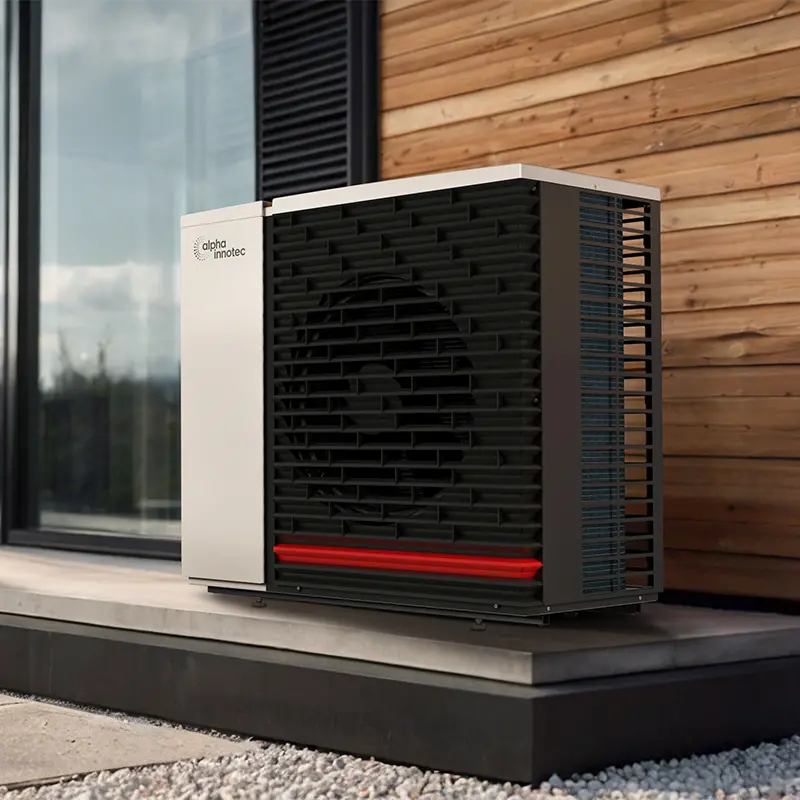
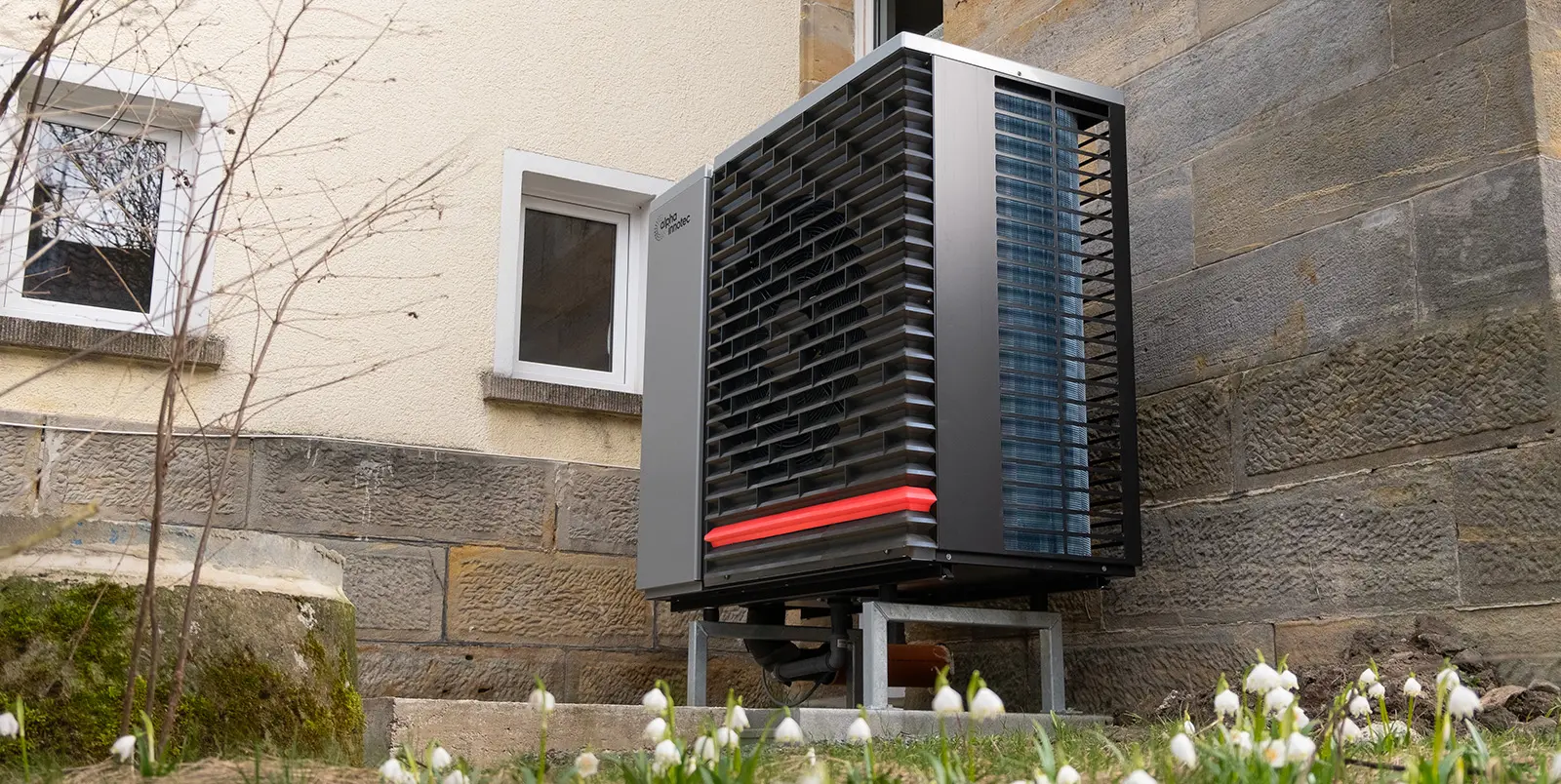
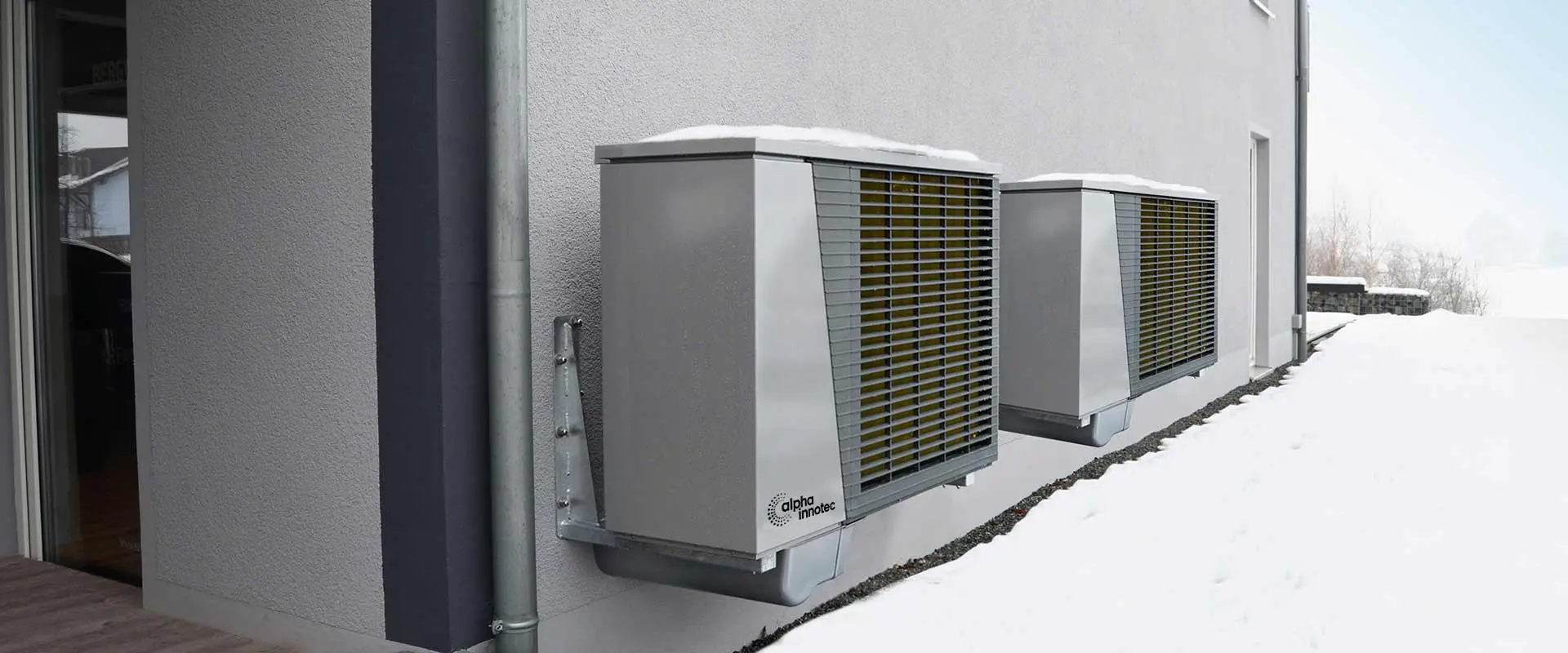
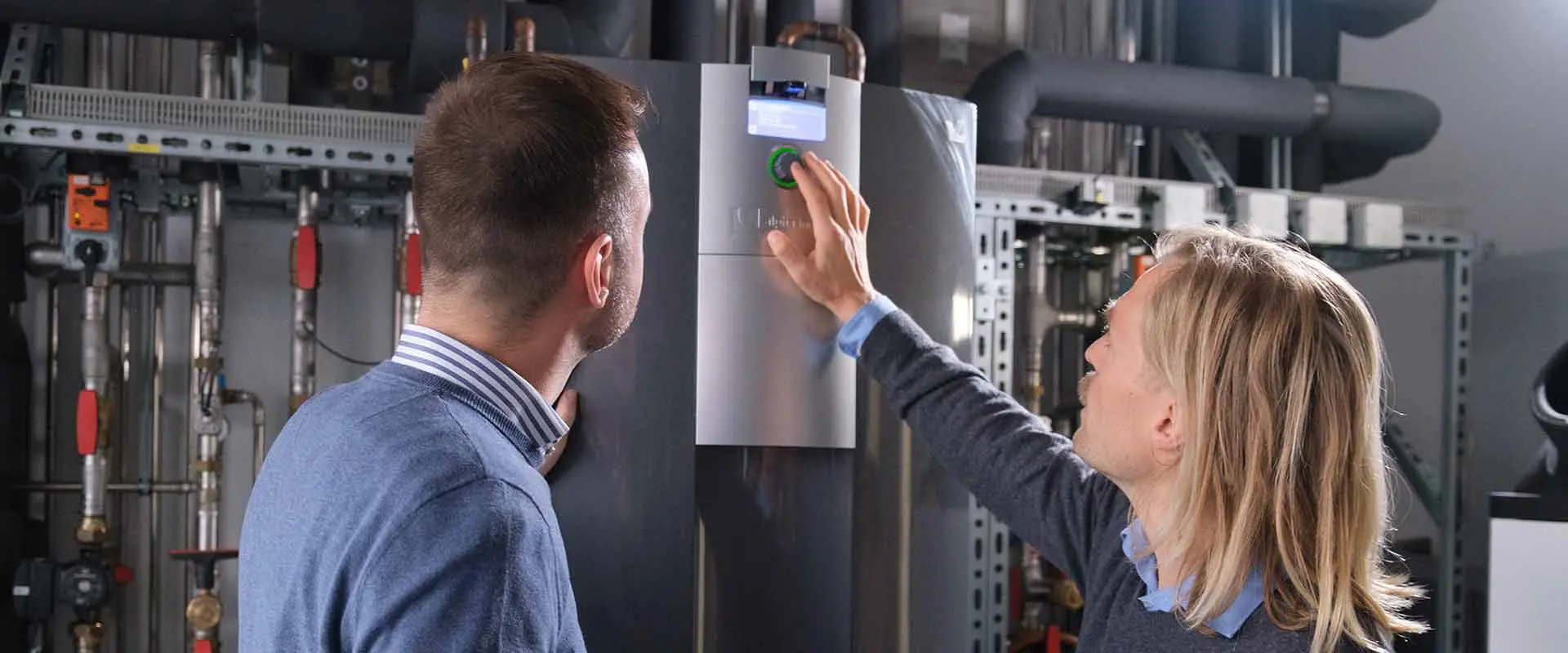
The SG-Ready Interface for Heat Pumps
The SG-Ready label lets you see at a glance whether your new heat pump is equipped with a dedicated SG-Ready interface and is therefore prepared for an intelligent power grid – the so-called smart grid.
It was introduced as early as 2012 by the German Heat Pump Association (BWP) together with 17 heat pump manufacturers and applies exclusively in Germany, Austria, and Switzerland.
alpha innotec was involved from the very beginning and offers only smart-grid-ready heat pumps.
The most important facts in 10 seconds
- SG Ready identifies heat pumps that feature an interface for external control and can therefore be intelligently connected to the grid, a PV system, and an energy management system.
- Using four defined operating modes, energy suppliers or energy managers can block, operate normally, or deliberately “boost” the heat pump, for example when there is a PV surplus.
- SG-Ready heat pumps help smooth grid peaks, optimize the use of PV electricity, and reduce electricity costs.
- For many government funding programs, a grid-supportive, controllable heat pump is now a requirement.
- In many cases, SG-Ready functionality can be retrofitted or expanded via the controller, energy manager, and PV system.
What is a smart grid?
In an intelligent power grid, also known as a smart grid, electricity generation, storage, and consumption are better coordinated with each other. Different energy sources are naturally not always available continuously, and fluctuations must be balanced to keep the grid stable and prevent line overloads.
“Smart” in this context means that processes are automated using information, communication, and data technology. This is mainly because more and more energy sources are decentralized (e.g. photovoltaic systems on your roof) and must be coordinated with consumers such as heat pumps or wallboxes.
What does SG-Ready mean?
“SG” stands for smart grid. An SG-Ready heat pump is equipped with a defined interface that allows it to receive external control signals. These signals can come from an energy supplier, a smart meter gateway, an energy manager, or your own photovoltaic system.
As part of intelligent load management, SG-Ready heat pumps can be controlled via this interface. Your energy supplier or energy manager can, for example:
- temporarily restrict operation to avoid grid peaks, or
- deliberately activate the heat pump when a lot of renewable electricity is available in the grid.
Conversely, your heat pump can use surplus electricity to heat up the buffer tank or domestic hot water tank.
In short:
SG-Ready means that your heat pump doesn’t just run “on” or “off” – it can respond intelligently to external signals.
Are SG-Ready heat pumps mandatory?
Currently, there is no obligation in Germany to install only heat pumps with an SG-Ready interface. However, there are other good reasons to choose a smart-grid-capable heat pump: you will only receive attractive government funding if your heat pump can be controlled for grid-supportive load management.
How does the SG-Ready interface work?
n practice, the SG-Ready interface consists of potential-free contacts (relay inputs) on the heat pump. These are connected to a higher-level system, for example:
- a signal from the energy supplier (ripple control receiver),
- a smart meter gateway,
- a PV energy manager or inverter,
- a smart home control unit.
Via this wiring, digital signals are transmitted to the heat pump controller. Depending on the combination of incoming signals (e.g. 2 contacts → 4 possible states), the controller recognizes which operating mode it should run in.
Where is SG-Ready connected?
At the heat pump controller, using the designated SG-Ready or utility (EVU) terminals.
What connections are required for an SG-Ready heat pump?
At minimum, SG-Ready terminals on the controller, a control cable to the higher-level control system (energy manager, ripple control receiver, PV inverter), and ideally a suitable buffer tank or domestic hot water tank.
The four operating modes of an SG-Ready heat pump
The controller of an SG-Ready heating heat pump must be able to switch into at least the following four operating modes. Control is carried out either via a digital radio signal from your energy supplier or via a higher-level controller that communicates with your heat pump and PV inverter.

Operating mode 1
To avoid load peaks and strong frequency fluctuations in the grid, the energy supplier may disconnect your heat pump from the grid up to three times a day for up to 120 minutes each time. The subsequent heating phase must be at least as long as the preceding blocking period.
This utility blocking does not mean that you have to freeze. With a buffer tank or underfloor heating, these blocking periods can easily be bridged, as they silently take over heat supply. An electric heating element can also be used, although it then operates with more expensive electricity.
Operating mode 2
Your heat pump runs in energy-efficient normal operation. The heat pump controller ensures that the storage tank is well charged before a blocking period begins. This also means that your heat pump must be adequately sized. Be sure to seek advice from a heat pump professional before purchasing. Proper sizing of the heat pump and buffer tank saves a lot of money in the long run.
Operating mode 3
The heat pump switches to an intensified mode for heating and domestic hot water preparation when your PV system produces surplus electricity. This ensures that your self-generated electricity is used to operate the heat pump. Since compressor switching should be intelligent and efficient, this is not a mandatory start command, but rather a recommendation to switch on.
Operating mode 4
F
For this mode, various tariff and usage models must be configurable for different control strategies in the controller. A definitive command is issued to actively switch on heating, optionally combined with a temperature increase in the thermal storage tank.
Detailed regulations can be found on the website of the German Heat Pump Association (BWP).
The benefits of an SG-Ready heat pump
An SG-Ready heat pump offers several advantages:
- Lower electricity costs: Use of low-tariff periods and PV surplus instead of expensive grid electricity.
- Higher PV self-consumption: Self-generated electricity is primarily used in your own home rather than being fed into the grid at low feed-in tariffs.
- Support grid stability: SG-Ready heat pumps help smooth grid peaks and contribute to grid-friendly operation.
- Future-proof: Intelligent interfaces are the foundation for smart grids, dynamic tariffs, and modern energy management systems.
- Eligibility for funding: For many government funding programs, a controllable, grid-supportive heat pump is now a prerequisite.

SG-Ready in combination with your PV system
The SG-Ready interface can do much more than just respond to signals from the energy supplier. In combination with a photovoltaic system, it becomes the key to cost-efficient heating using your own solar power.
How does communication work?
There is continuous communication between the PV system, heat pump, and buffer tank, controlled for example by:
- a PV inverter with energy management functionality,
- an external energy manager that monitors household consumption, feed-in, and storage.
Instead of simply feeding surplus electricity into the public grid, your heat pump automatically uses it to:
- heat the domestic hot water tank to a slightly higher temperature level, or
- pre-charge the heating buffer tank.
This converts electrical energy into thermal energy that you can later use for heating, showering, or bathing.
Why is this more cost-effective?
Feed-in tariffs per kilowatt-hour are usually significantly lower than the price of electricity for operating your heat pump. From a financial perspective, it almost always makes sense to use as much self-generated electricity as possible yourself rather than selling it to the grid.
Retrofitting SG-Ready – is it possible?
Whether SG-Ready can be retrofitted depends on your heat pump model and the existing controller.
Typical scenarios:
- Some modern heat pumps already have a prepared SG-Ready interface that only needs to be connected and configured.
- Other systems may require an expansion board, a new controller, or an external energy manager.
- In older systems without suitable electronics, retrofitting may be complex or uneconomical.
As a rough guideline, manageable costs can be expected for wiring, configuration, and integration into an existing energy management system (e.g. electrician and installer services). Whether it pays off depends on how much PV self-consumption you can generate and whether you benefit from dynamic tariffs or future grid functions.
Common mistakes & typical problems with SG-Ready
For SG-Ready to work reliably in everyday use, several points must be considered. Typical sources of error include:
- Incorrect contact assignment: SG-Ready terminals are not connected correctly, so signals do not arrive or trigger incorrect states.
- Misconfiguration in the energy manager: PV or smart home systems do not send suitable signals because the logic is not properly set up.
- No communication with the PV system: The inverter provides surplus information, but it is not passed on to the heat pump.
- Buffer tank too small or incorrectly configured: Surplus energy cannot be absorbed efficiently, causing frequent on/off cycling.
- Utility blocking times not considered: The system is not charged in time beforehand, leading to unnecessary cooling during blocking phases.
Checklist: Is my heat pump SG-Ready?
A short checklist helps you determine whether your heat pump is SG-Ready or suitable for it:
- Check model & data sheet
– Does the data sheet mention “SG Ready,” “Smart Grid Ready,” or “externally controllable”?
– Is there a reference to a utility input or SG-Ready terminals? - Inspect controller & terminals
– Does the controller have clearly labeled terminals (utility block, SG, smart grid)?
– Are the required inputs free and accessible? - PV system / energy manager
– Does your PV system or energy manager have outputs for consumer control?
– Can switching thresholds or modes (e.g. “PV surplus”) be configured? - Installation documents / installer
– Did your installer mention or document SG-Ready?
– Are there wiring diagrams showing SG-Ready signals? - Funding & future readiness
– Does your system meet the requirements for government funding (controllable, grid-supportive)?
– Is the interface designed to enable future smart grid applications?
If you are unsure about any of these points, a quick check with a heat pump professional or directly with the manufacturer is worthwhile.
Conclusion
SG-Ready heat pumps combine the best of two worlds: they use renewable energy for heating while intelligently adapting their operation to grid conditions, PV surplus, and tariffs. The label shows that your system is technically prepared to become an active part of the smart grid.

_Referenz%20Neustadt%20am%20R%C3%BCbenberge.webp)
.webp)

.webp)