Heat pump in refurbishment
Invest in the future – make a sustainable decision with a heat pump
The most important facts in 10 seconds
- Heat pumps also work in older buildings—with the right conditions.
- A flow temperature < 55 °C and good insulation are ideal.
- Subsidies of up to 70% make the switch affordable.
- Replacing old radiators or hybrid solutions ensures efficiency.
- Combining them with photovoltaics reduces operating costs to almost zero.
- Property values can increase by up to €20,000.
Heat pumps for older buildings – the eco-friendly alternative to oil or gas heating
More and more property owners are saying goodbye to their oil or gas heating systems in the course of renovation work and switching to heat pumps.
And with good reason: most heating systems in existing/old buildings are outdated and inefficient. When you consider that heating and hot water account for around 85% of a household's energy consumption in Germany, the need for efficient, sustainable, and responsible heating systems such as heat pumps becomes even more apparent. This is because a heat pump minimizes energy losses, saves resources, reduces costs in the long term, and maintains the value of the property in the long run. And don't worry: converting to a heat pump is much less complicated than you might think. Often, the existing heat distribution systems and building insulation in older buildings are already sufficient to operate a heat pump in an energy-efficient manner.

Why use a heat pump in refurbishment projects?
When considering the advantages in terms of living comfort combined with ecological aspects, it becomes clear that the performance of heat pumps is hard to beat by other heating systems. Heat pumps not only represent environmentally friendly and efficient heating, but also a more sustainable future for us and future generations. If the heat pump is also powered by green electricity, it is even completely CO2-neutral. This also applies, of course, if self-generated photovoltaic electricity is used to power it.
Options for renovation with a heat pump
A heat pump can be flexibly integrated into various renovation concepts:
- Direct replacement: Remove oil or gas heating and install a heat pump – air-to-water heat pumps are particularly popular.
- Radiator replacement: Low-temperature or panel radiators ensure efficiency.
- Hybrid solution: Heat pump + peak load boiler (gas or oil) for unrenovated old buildings with high heating requirements.
- Photovoltaics with heat pump: Own electricity covers electricity requirements, cooling in summer practically free of charge.
Advantages and disadvantages of a heat pump in an old building
✅ Advantages | ❌ Disadvantages |
Independence from oil and gas | Higher investment costs than fossil fuel heating systems |
Climate-friendly: up to 70% less CO₂ emissions | Efficiency decreases in unrenovated buildings |
Increases property value (up to €20,000) | Radiators often need to be adjusted |
| Future-proof thanks to GEG & rising CO₂ prices | Outdoor unit requires space and sound insulation |
Increase in property value thanks to the heat pump
Heat pumps are not only good for the climate, they also increase property values in the long term. This is because the use of a modern, energy-efficient heating system also improves the building's energy performance certificate.
Requirements for heat pumps in older buildings
To ensure that a heat pump works efficiently in existing buildings, a number of technical and structural factors should be checked:
✅ Insulation: The better the building envelope, the less heat loss.
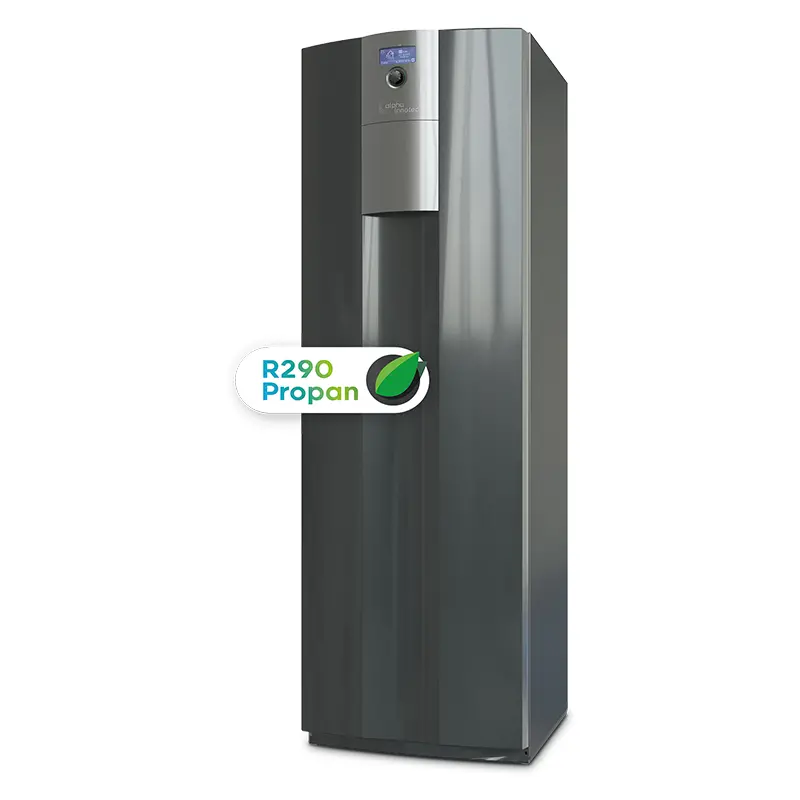
✅ Flow temperature: Ideally below 55 °C; modern R290 heat pumps can also achieve higher temperatures for radiators.
✅ Heating surfaces: Floor or wall heating is perfect. Large surface radiators or fan coil units also work.
✅ Hydraulic balancing: Mandatory for eligibility for subsidies and efficiency.
✅ Space requirements: Outdoor space for outdoor unit or technical room in the basement.
Heat pump check: Can a heat pump work in an existing building?
Four myths about refurbishment with heat pumps
1. A HEAT PUMP ONLY WORKS WITH UNDERFLOOR HEATING!
Wrong. Heat pumps work best with low flow temperatures and are most efficient when they release their heat over a large heating surface. This can also be achieved using larger radiators or so-called low-temperature radiators, which have a low flow temperature.
2. A HEAT PUMP ONLY WORKS AFTER A COMPLETE RENOVATION!
Wrong, heat pumps work most efficiently when heat loss through the building envelope is kept to a minimum. Often, minor measures on existing buildings are sufficient to ensure economical operation of the heat pump.
3. A HEAT PUMP REQUIRES A LOT OF ELECTRICITY!
Wrong, heat pumps are highly efficient thanks to the additional use of environmental energy. Under certain conditions, they can generate 5 kilowatts of heat from just 1 kilowatt of electricity.
4. A HEAT PUMP IS MUCH MORE EXPENSIVE THAN A CONVENTIONAL OIL OR GAS HEATING SYSTEM!
Wrong. Even when using a conventional oil or gas heating system, part of the energy required must be generated from a renewable source in order to achieve a certain energy standard. This means that using a heat pump is often the most economical decision.
Conclusion
The heat pump is a climate-friendly, future-proof heating solution. It reduces CO₂, makes you less dependent on fossil fuels, and increases the value of your property. With subsidies of up to 70% and the option of combining it with photovoltaics, it is also financially attractive.



_Referenz%20Neustadt%20am%20R%C3%BCbenberge.webp)








.webp)



.webp)